
Efficiency
28 August 2026
8 min.

Efficiency
27 July 2026
11 min.

Artificial intelligence in the workplace is no longer a topic reserved for IT teams, innovation committees, or early adopters who enjoy experimenting with new tools. It is already becoming part of everyday work — whether it is used to summarize a document, draft an email, organize a presentation, prepare for a meeting, or simply save a few minutes on a busy day.
But while some people are actively experimenting, others are hesitant. They may not know where to begin, worry about using AI incorrectly, or wonder what is allowed, what is risky, and what is actually useful. For others, the hesitation runs deeper. They may have ethical concerns, fear that their expertise will be devalued, feel anxious about the changes ahead, or simply struggle to see how AI could benefit them in practical terms.
This leaves organizations facing a very real challenge: how can they support AI adoption without creating more confusion, pressure, or division within their teams?
The answer is not simply to choose a tool or offer a quick introduction to prompting. Effective workplace AI training should help teams build shared habits: using AI thoughtfully, protecting data, collaborating more clearly, and maintaining control over the quality of their work — without losing sight of the human side of the transformation.
AI adoption rarely happens in a neat, orderly way. In many organizations, it begins with individual experimentation. One person discovers a tool, starts using it in their work, tells a few colleagues about it, and before long, usage spreads faster than the guidelines.
The issue is not a lack of interest or willingness. Many people want to learn, save time, and work more effectively. But they are trying to navigate a fast-moving field, constantly evolving tools, unclear rules, and expectations that are not always clearly communicated.
As a result, some people feel energized, while others feel overwhelmed. Some already use AI every week, while others are still uncomfortable asking basic questions. Managers, meanwhile, are often expected to guide the transition without knowing exactly what to encourage, what to regulate, or what to avoid.
That is why AI in the workplace is not just a technology issue. It is also a question of skills, culture, collaboration, and accountability.
Without shared guidelines, AI may help speed up certain tasks, but it can also magnify problems that already exist — such as unclear roles, inconsistent review processes, hidden workloads, uneven quality, or poor data management.
Before trying to move faster, organizations need to help teams understand what they are doing with AI, why they are doing it, and where the boundaries lie.
It can be tempting to start with the tools. Which platform should be approved? What training should be offered? What guide should be sent to everyone? These are useful questions, but they should not be the starting point.
Before training teams on AI, organizations first need to clarify how they want it to be used. In practical terms, what should AI help people do at work? Generate ideas? Summarize information? Rewrite content? Prepare questions? Automate simple steps? All of these use cases may be relevant, but they do not carry the same level of risk.
Summarizing a public article is very different from processing personal information, producing a strategic recommendation, or drafting a sensitive communication. A strong first step is therefore to map current practices. Who is already using AI? For which tasks? With which tools? And with what level of review?
These questions help uncover the team’s real training needs. Some teams may need a shared foundation. Others may need clearer guardrails. Still others may benefit from strengthening their critical thinking, collaboration, or cybersecurity skills.
The goal is not to control everything. It is to create enough clarity for people to move forward independently, without having to navigate AI in the dark.
Discover our online training courses to better understand, use, and integrate AI effectively at work

AI upskilling is not about turning everyone into an artificial intelligence specialist. In most organizations, the goal is much more practical: helping teams use AI in ways that are useful, responsible, and relevant to their day-to-day work.
Before even discussing generative AI, many teams need to strengthen their digital agility. Digital agility is not about mastering every new tool that comes along. It is the ability to explore, learn, adapt, and remain relatively comfortable in a digital environment that is constantly changing.
This is an essential foundation. When technology feels intimidating, pointless, or at odds with people’s professional and ethical concerns, AI can become a source of distrust or anxiety rather than a useful resource. By becoming more curious and comfortable with technology, teams are better equipped to experiment, ask questions, understand a tool’s limitations, and learn at their own pace.
Many people already use generative AI intuitively. To get more value from it, they need to learn how to give clear instructions, provide the right context, define the intended outcome, compare responses, and recognize the tool’s limitations.
Training teams on generative AI is therefore not just about teaching them to write better prompts. It is about helping them develop sound habits, use the technology thoughtfully, and remain accountable for the final result.
One of the biggest risks of AI is its ability to produce highly convincing answers that may still be incomplete, biased, or inaccurate. A response can sound clear, polished, and well structured without being fully reliable.
Critical thinking in the age of AI means knowing when to step back and ask the right questions. Is this accurate? Is it appropriate for the context? Is it nuanced enough? Is it supported by reliable sources? Does it make sense for our situation?
Focusing on the tools without strengthening judgment is like giving someone an accelerator without teaching them how to drive. AI should not make decisions for us. Teams need to learn how to use it with discernment.
AI does not only change individual tasks. It also changes how people work together. Who uses the tool? Who reviews the output? Who adjusts the content? Who remains accountable for the final deliverable?
Without shared expectations, AI can create hidden work. One person may complete a task more quickly, while someone else has to spend additional time correcting, refining, or fact-checking the result — without that extra effort being acknowledged.
Over time, this lack of clarity can lead to frustration, inconsistent quality, and a loss of trust.
AI training is incomplete without a discussion about cybersecurity. Copying sensitive data into a public tool, using an unapproved platform, or granting overly broad access can expose an organization to significant risk.
Good security habits need to be simple and practical: recognize sensitive information, anonymize data when necessary, use approved tools, manage access carefully, and report suspicious activity quickly. Responsible AI adoption depends on everyone remaining vigilant.
Find the training solutions adapted to your teams’ maturity level
A tool may be impressive, but if it does not address a real need, it risks becoming one more novelty that people quickly abandon. Before choosing a platform or training program, organizations need to understand which tasks AI could genuinely support, which risks need to be managed, and which everyday frustrations teams are trying to reduce.
The most curious people are often the first to volunteer. That is helpful, of course, but AI adoption cannot depend only on people who are already comfortable with the technology. Organizations also need to support those who are hesitant, unsure, or worried that they will not be able to keep up.
Within the same team, some people may already use AI every week, while others may not yet know how to write their first prompt. An AI upskilling initiative needs to account for these differences. Otherwise, it may bore some participants while leaving others behind.
Knowing how to write a good prompt is useful, but it is not enough. Training teams on AI also means strengthening judgment, review practices, collaboration, and security awareness. The goal is not simply to get an answer. It is to know how to evaluate it and what to do with it.
Team autonomy is essential, especially since AI use cases vary from one context to another. But without clear, shared guidelines that teams help shape, practices can quickly become inconsistent. The goal is not to impose a single rule on everyone. It is to help each team establish its own framework. Which use cases are appropriate? What needs to be reviewed? When should the use of AI be disclosed? What boundaries does the team want to set?
Guide AI use within your teams without losing human judgment
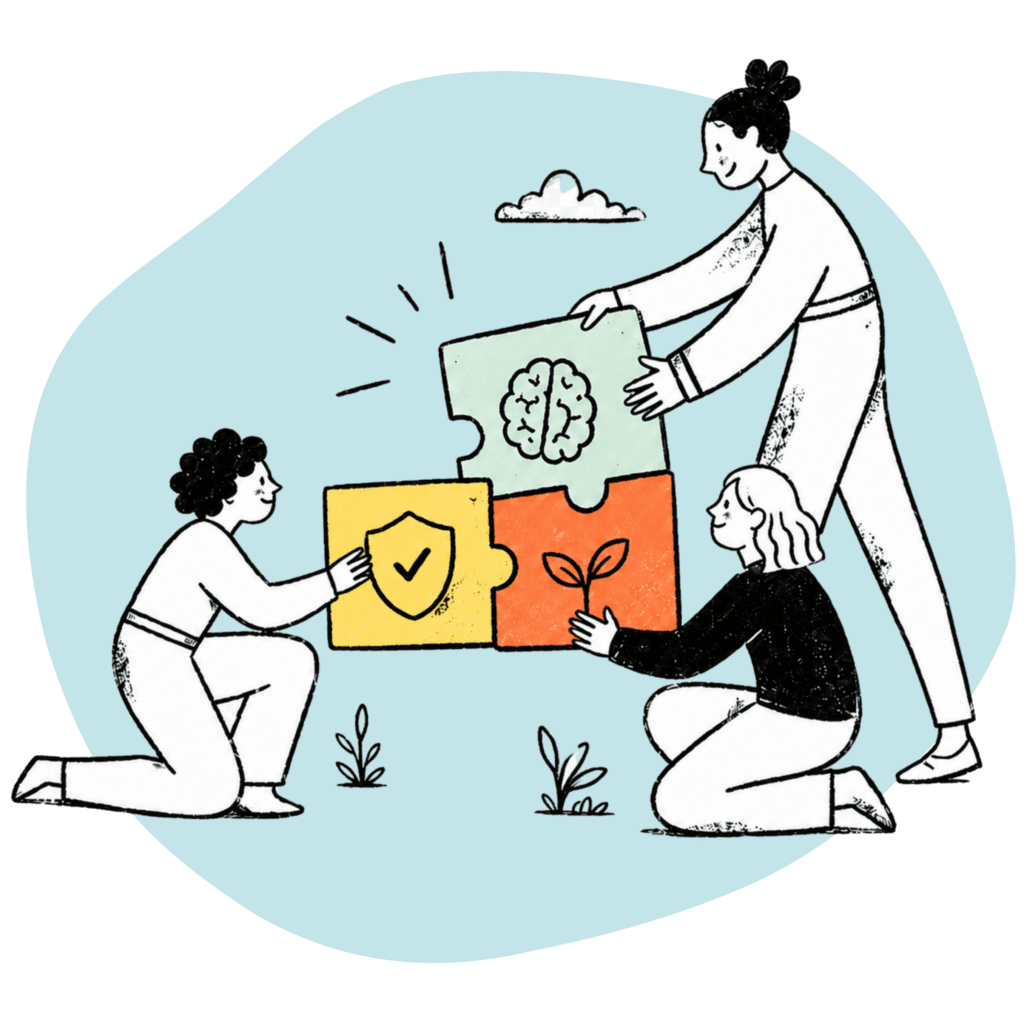
Organizations do not need to transform everything at once. A five-step approach can help them move forward in a way that feels clear, reassuring, and sustainable. Managers also have an important role to play. They can create space for open conversations about AI use, make it acceptable to ask questions, clarify expectations, and ensure that AI adoption is not perceived as a requirement to constantly produce more, faster.
The first step is to understand what is already happening, even informally. Who is using AI? For which tasks? With which tools? And with what level of review?
This mapping exercise helps identify useful practices, potential risks, and differences between teams. It also prevents organizations from building a training strategy based on assumptions rather than what is actually happening in the workplace.
It is better to begin with a small number of practical, useful, and relatively low-risk use cases than to try to transform everything at once.
For example, a team might begin by using AI to summarize documents, organize ideas, prepare for meetings, or rewrite internal content. These use cases give people a chance to develop good habits without exposing the organization to unnecessary risk.
Once the priority use cases have been identified, it becomes easier to clarify the rules of the game. Which information should never be shared? Which tools are approved? Which types of content need to be reviewed? Who remains accountable for the final result?
These guidelines do not need to be complicated to be effective. They simply need to be clear, widely understood, and easy to apply in day-to-day work.
Using AI requires more than technical know-how. It also calls for digital agility, critical thinking, strong collaborative habits, an understanding of risk, and the ability to use generative AI with discernment.
A skills-based approach also prevents teams from becoming overly dependent on a particular platform. Tools will change. Strong habits will continue to be useful.
A one-time training session can raise awareness, but lasting change happens when teams have opportunities to experiment, discuss what they are learning, adjust their practices, and revisit key concepts.
Organizations should therefore plan for follow-up activities, team conversations, practical examples, and gradual adjustments. This is how AI adoption becomes a shared practice rather than a series of isolated experiments.
AI can save time, support creativity, make analysis easier, and open up new possibilities. But successful adoption should not be measured only by how quickly people work or how many tools they use.
It also depends on the quality of decisions, the clarity of team practices, data security, trust, and the ability to keep human judgment at the centre of the process.
Training teams on AI is therefore not about asking them to work faster at all costs. It is about giving them the guidance they need to use powerful tools without losing their critical thinking, their ability to collaborate, or their sense of professional accountability.
To help organizations get started, Boostalab offers a range of workplace AI training solutions, including self-paced online training, an AI learning path for teams and managers, and targeted training on critical thinking, digital agility, collaboration, generative AI, and cybersecurity.
AI can transform the way we work. But it is well-equipped teams that give that transformation direction.

FAQ | AI in the workplace and team training
Training teams on AI helps them develop practices that are more useful, responsible, and aligned with the realities of their work. The goal is not simply to teach people how to use a tool. It is to strengthen the habits that support responsible use, including critical judgment, data protection, collaboration, content review, and clear accountability.
The best place to start is by understanding how AI is already being used. Before choosing a platform or training program, organizations need to know who is using AI, for which tasks, with which tools, and with what level of risk. This mapping exercise makes it easier to prioritize needs and build a realistic plan.
Successful AI adoption depends on several complementary skills: digital agility, responsible use of generative AI, critical thinking, collaboration, and cybersecurity. Together, these skills help teams use AI with discernment rather than becoming dependent on a specific tool.
No. Generative AI can support writing, analysis, summarization, and idea generation, but it does not replace human judgment. Its outputs still need to be reviewed, verified, contextualized, and adapted. That is why critical thinking remains essential in any AI training initiative.
Teams need clear guidelines to prevent confusion. They should agree on which use cases are appropriate, which information must never be shared, which content needs to be reviewed, when the use of AI should be disclosed, and who remains accountable for the final result. These shared expectations make AI adoption more consistent, responsible, and secure.
Blog
28 August 2026
8 min.

14 April 2026
5 min.

20 February 2026
6 min.
Nos ressources gratuites vous donneront un avant-goût de nos solutions et vous permettront de faire des premiers pas pour transformer votre organisation!
Pourquoi ça vaut la peine d’y réfléchir? Parce que la connaissance de son propre style et du style de l’autre permet d’être plus efficace dans ses relations interpersonnelles, à la maison comme au travail.
Alors, quel est votre style de communication?