
Human resource management
10 July 2026
6 min.

Human resource management
10 February 2026
7 min.

Training your teams is no longer optional. It’s a necessity. Skills are evolving quickly, employee expectations are shifting just as fast, and organizations need to keep pace to stay relevant and attractive. In this context, one question keeps coming up: is it better to purchase individual courses as needed, or invest in a corporate training portal?
Behind this choice are two complementary approaches that reflect different levels of organizational maturity and distinct needs. Each has unique long-term impacts—on learning consistency, employee engagement, and organizational culture.
Purchasing individual training courses remains one of the most common options in organizations. This approach allows you to quickly address a specific need, whether it’s to:
✓ Develop a specific skill
✓ Support someone in their role
✓ Take effective action in a particular situation
Simple to implement, individual courses offer great flexibility and work well for organizations that want to move quickly—without committing to a long-term corporate training portal or LMS platform.
Individual training also allows for strong personalization. Employees or teams can access content that’s directly connected to their day-to-day reality and immediate priorities. Training platforms like Le Lab by Boostalab make this type of individual learning easily accessible, fast, and cost-effective.
When used intentionally, individual courses play an important role in skills development. They make it possible to explore new topics, test out content, and respond to emerging challenges—while supporting professional autonomy. This approach fosters engagement and often helps spark, or strengthen, a culture of learning within the organization.
To fully benefit from individual training, however, it’s essential to anchor selected courses within a broader strategy. Even when chosen one at a time, courses should align with organizational objectives to ensure they contribute coherently to long-term skills development and evolving practices.
Learn at your own pace, according to your needs, when it’s convenient for you
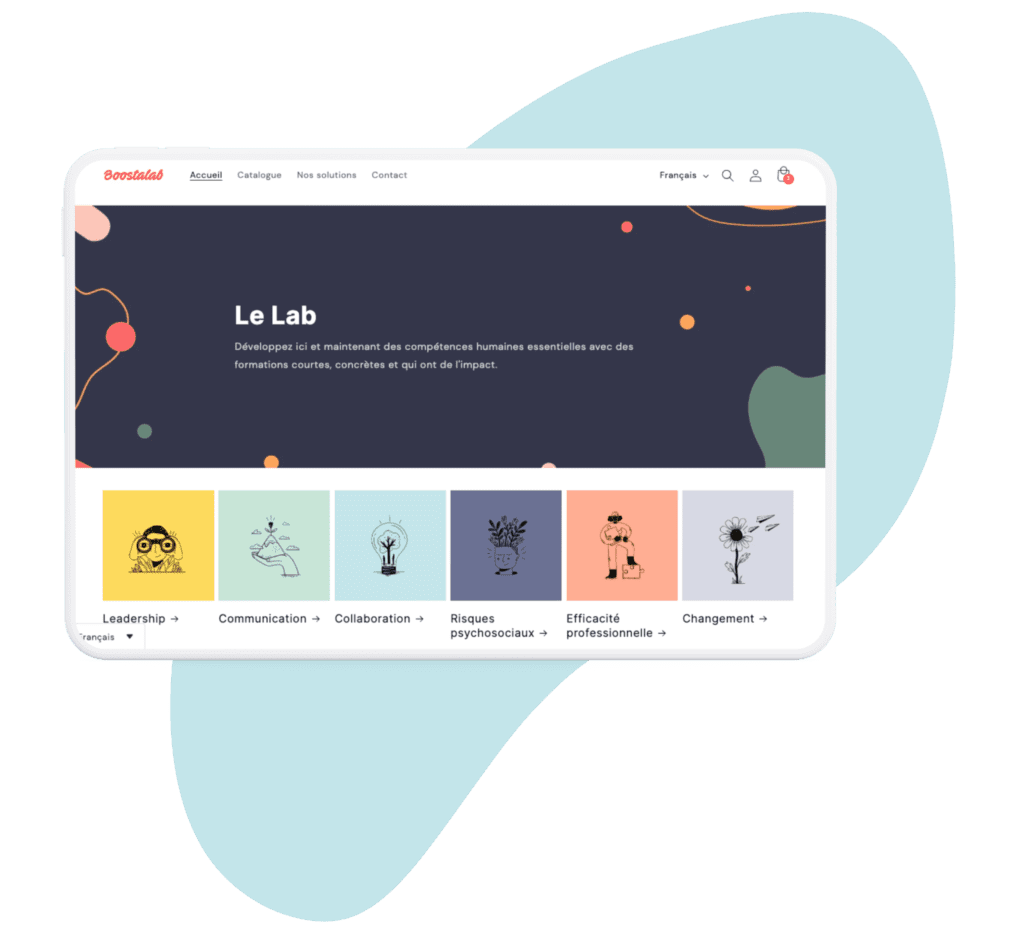
A corporate training portal represents a more structured and strategic approach to skills development. By centralizing all training content within a single environment, a corporate portal makes learning more accessible while providing a clear and cohesive organization-wide vision.
Often supported by a Learning Management System (LMS)—also referred to as an online LMS or e-learning LMS—this type of portal allows organizations to structure training logically, support continuous learning, and foster a common language across teams. A well-designed corporate training portal strengthens alignment in practices while allowing employees to learn at their own pace, based on their needs.
Beyond the tool itself, the portal becomes a true organizational lever. A corporate training portal simplifies training management, supports team engagement, and sends a clear message: skills development is an integral part of the organization’s vision and priorities.
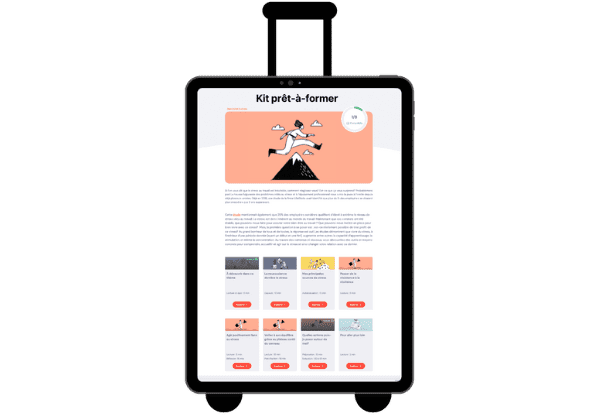
Get turnkey training content that’s easy to integrate into your organization’s LMS
Rather than opposing individual training and a corporate training portal, certain questions can help clarify what truly fits your organization.
According to Deloitte’s 2025 Global Human Capital Trends report, leaders must ask essential questions about access, development, and organizational culture to guide their human capital investments—particularly when structuring learning and skills development across the organization. (1)
When individual courses are selected independently, each team moves forward based on its own priorities—which can be relevant in an exploratory phase. Content and approaches may vary, making alignment and the creation of a common language more complex. The question then becomes: how can we ensure that learning supports a shared vision? A corporate training portal helps structure training around common reference points and strengthens organization-wide consistency.
Who gets access to training, and under what conditions? When training is purchased individually, access often depends on budget or managerial approval. An online LMS within a corporate training portal facilitates more consistent access to content and allows everyone to learn at their own pace—reinforcing autonomy, inclusion, and engagement.
A one-time course can address a specific need—but how do we ensure its impact extends beyond the moment? Without continuity, learning struggles to become embedded in daily work. An e-learning LMS integrated into a corporate training portal supports an ongoing learning dynamic connected to real work, fostering more sustainable engagement. (2)
Multiplying individual course purchases involves research, registration, coordination, and follow-up. Over time, this workload can become significant. A corporate training portal centralizes training management, streamlines processes, and reduces administrative burden—freeing up time for higher-value activities.
Dealing with specific issues? Boostalab creates custom training courses to create heal behaviour change that sticks

It’s important to say this clearly: there is no universal solution. In many organizations, individual training is the first step toward a more structured approach. Individual courses can be relevant for smaller organizations, when needs are infrequent or highly targeted, or when training has not yet become a strategic priority. This approach also allows organizations to test content and identify recurring themes internally before investing in a full corporate training portal or LMS platform.
An online LMS or corporate training portal becomes particularly relevant as the organization grows, teams become hybrid or geographically dispersed, people-related challenges take on greater importance, and training becomes part of a long-term strategic vision.
That said, not all organizations necessarily have the resources, time, or in-house expertise to implement and manage their own LMS. This constraint is common—and entirely legitimate.
In this context, intermediate solutions make perfect sense. For example, a corporate subscription to Le Lab by Boostalab allows organizations to offer their teams a turnkey corporate training portal—without having to develop or manage an internal LMS. Teams benefit from:
✓ A structured environment
✓ Centralized access to training
✓ A learning experience designed for everyday professional realities
This approach captures many of the advantages of a corporate training portal—consistency, accessibility, and continuity—while remaining accessible to organizations with more limited resources. It supports a culture of learning and development without the technological complexity often associated with traditional LMS platforms.
Offrez à vos équipes un portail de formation d’entreprise prêt à l’emploi, sans lourdeur technologique

Beyond tools and formats, the central question is not whether to choose individual courses or a corporate training portal. The real question is how to invest in a coherent and sustainable skills development strategy—one aligned with your organization’s vision, priorities, and people-related challenges.
Adopting a corporate training portal—or a solution built on the same principles—is not simply a technological decision. It’s a strong signal to teams that learning is part of the job and that professional development is supported over time.
Individual courses can meet short-term needs. Structuring training through a corporate training portal, however, helps build a more cohesive, agile organization—better equipped for the future.
The real question isn’t how much training costs. It’s what kind of organization you want to become.
Fully designed by a local team and built to integrate naturally into your day-to-day work—without adding to your workload

Blog
10 July 2026
6 min.

26 June 2026
11 min.

20 June 2026
4 min.
Nos ressources gratuites vous donneront un avant-goût de nos solutions et vous permettront de faire des premiers pas pour transformer votre organisation!
Pourquoi ça vaut la peine d’y réfléchir? Parce que la connaissance de son propre style et du style de l’autre permet d’être plus efficace dans ses relations interpersonnelles, à la maison comme au travail.
Alors, quel est votre style de communication?